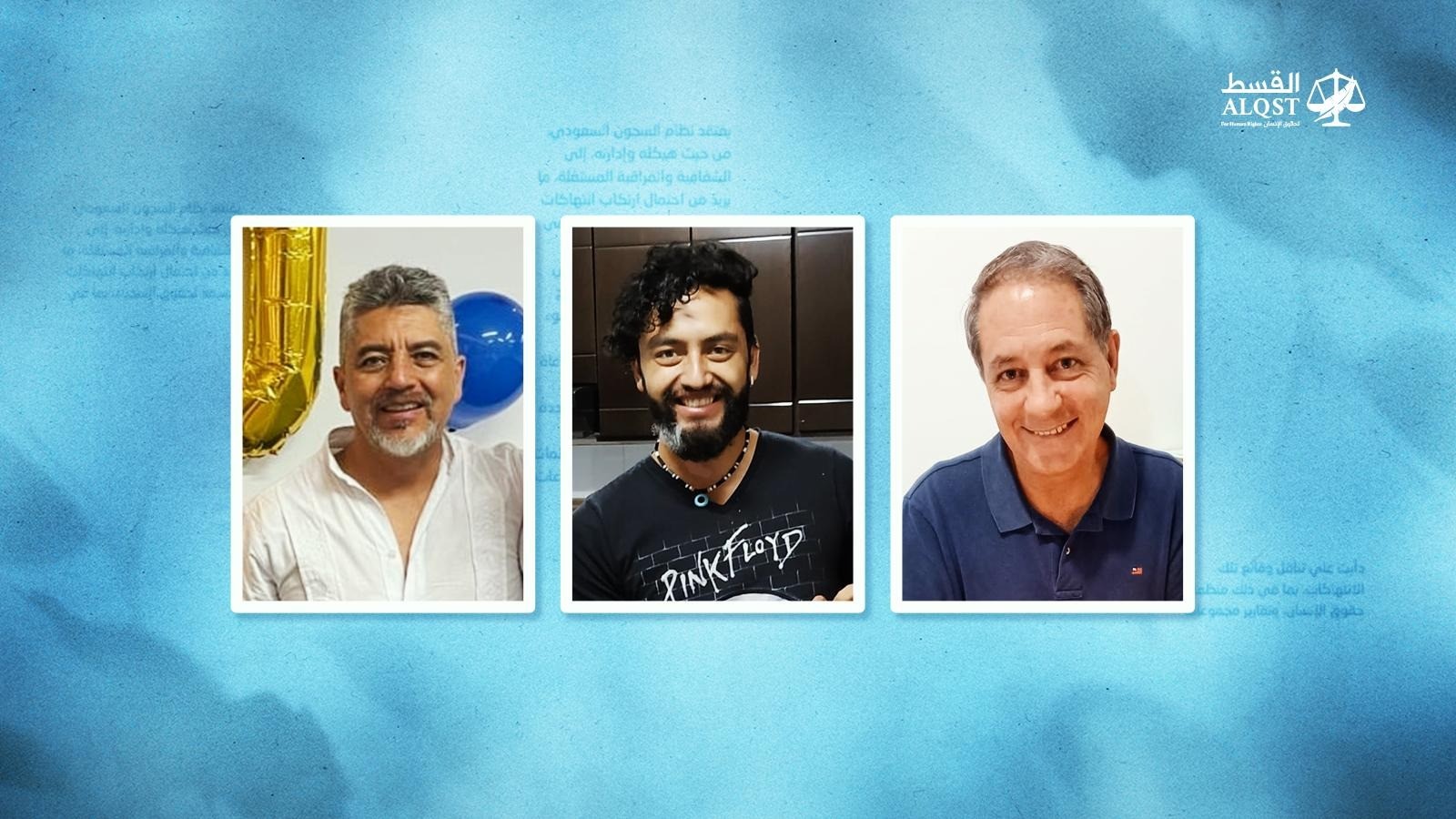
Three Colombian engineers have been detained and held incommunicado in Saudi Arabia since early 2026, raising serious concerns for their health and wellbeing. The men spent three months in detention in Aden, Yemen, before being transferred to Saudi Arabia after Saudi-backed forces took control of the city. They were forcibly disappeared until late June, when the authorities finally notified the Colombian government of their whereabouts in Abha Prison. ALQST has submitted their case to the United Nations Working Group on Enforced or Involuntary Disappearances (UN WGEID) and calls on the Saudi authorities to immediately grant them contact with their families, and ensure Colombian consular officials can visit them.
Colombian nationals and U.S. residents Héctor Eduardo Romero Ramírez (53) (pictured left), his son Luis Eduardo Romero Jiménez (31) (pictured centre), and Mauricio Patiño Gallego (62) (pictured right), a dual Colombian-U.S. citizen, arrived in Yemen's capital, Sana'a, on 22 April 2025. Their employer, US-based Fihiza Solutions Inc, had been contracted to install civilian satellite antennas in the city. After completing the project in July 2025, the three men sought to leave Yemen. However, Israeli airstrikes on Sana’a International Airport made it impossible to depart by their original route. Following advice from the Colombian Embassy in Abu Dhabi and the International Organisation for Migration (IOM), they travelled to southern Yemen with the intention of leaving the country through Aden Airport.
Instead, in Aden they were detained by security forces, interrogated and forced to sign confessions written in Arabic, without access to either a lawyer or an interpreter. On 4 January 2026, the International Committee of the Red Cross (ICRC) Aden Mission visited the detention facility, confirmed the men’s presence to their families, and provided medical assistance. The families received their last communication from the detainees – a phone call in which the men confirmed that they were being held in a detention facility in Aden, in poor conditions that were negatively affecting their health – on 25 January.
Sometime between 25 January and 5 February 2026, when Saudi-backed forces entered Aden and regained control from the Southern Transitional Council (STC), the men were transferred to Saudi Arabia without clear legal process, where they were forcibly disappeared. They have been denied any contact with the outside world, including their families, lawyers or embassy officials, thereby violating Saudi Arabia’s international obligations under the Vienna Convention on Consular Relations.
Despite repeated requests from the Colombian Embassy, Saudi authorities have provided very little information, stating only that the men are in Saudi custody in connection with a national security investigation and that Colombia will be informed “once the case has concluded”. For months, the authorities did not disclose where the men were being held or their legal status. Combined with their prolonged incommunicado detention, these circumstances amount to enforced disappearance.
In June 2026, ALQST submitted an urgent appeal to the UN WGEID. Enforced disappearance remains a systematic practice in Saudi Arabia and is frequently used against prisoners of conscience and other victims of human rights abuses. By placing individuals outside the protection of the law, enforced disappearance exposes them to a heightened risk of torture and other serious violations. During its fourth Universal Periodic Review in 2024, Saudi Arabia accepted a recommendation to ratify the International Convention for the Protection of All Persons from Enforced Disappearance, but has yet to take any steps towards doing so.
In late June, Saudi authorities finally informed the Colombian government of their whereabouts: Abha Prison, in Saudi Arabia’s southwestern Asir province. Despite this, they continue to be denied contact with their families and Colombian consular officials.
This case has unfolded against the backdrop of Yemen’s internal conflict. Since Saudi Arabia led a military intervention in Yemen in 2015, civilians travelling between areas controlled by different factions have often faced suspicion, arbitrary detention, coercive interrogation and torture to extract confessions. The situation became even more fragmented after 2019 as tensions grew between Saudi-backed and UAE-backed forces. Colombians came under further scrutiny because of reports that the UAE had recruited Colombian mercenaries to operate in the region. In January 2026, Saudi-backed forces seized Aden from the UAE-backed Southern Transitional Council (STC), assuming control of the city’s governing institutions, including detention facilities and parts of the judicial system.
Despite this complex security context, the Saudi authorities have an obligation to provide a lawful basis for detaining the three engineers, which they have repeatedly failed to do. The men had no involvement in military activities and no affiliation with any party to the conflict. The satellite systems they installed were intended solely for civilian and commercial use and were neither supplied for nor connected to any military purpose.
ALQST urges the Saudi authorities to immediately and unconditionally release Héctor Eduardo Romero Ramírez, Luis Eduardo Romero Jiménez and Mauricio Patiño Gallego. In the meantime, they must inform their families of their legal status; clarify any charges against them; and ensure they have regular access to their families, lawyers of their choosing and Colombian consular officials.