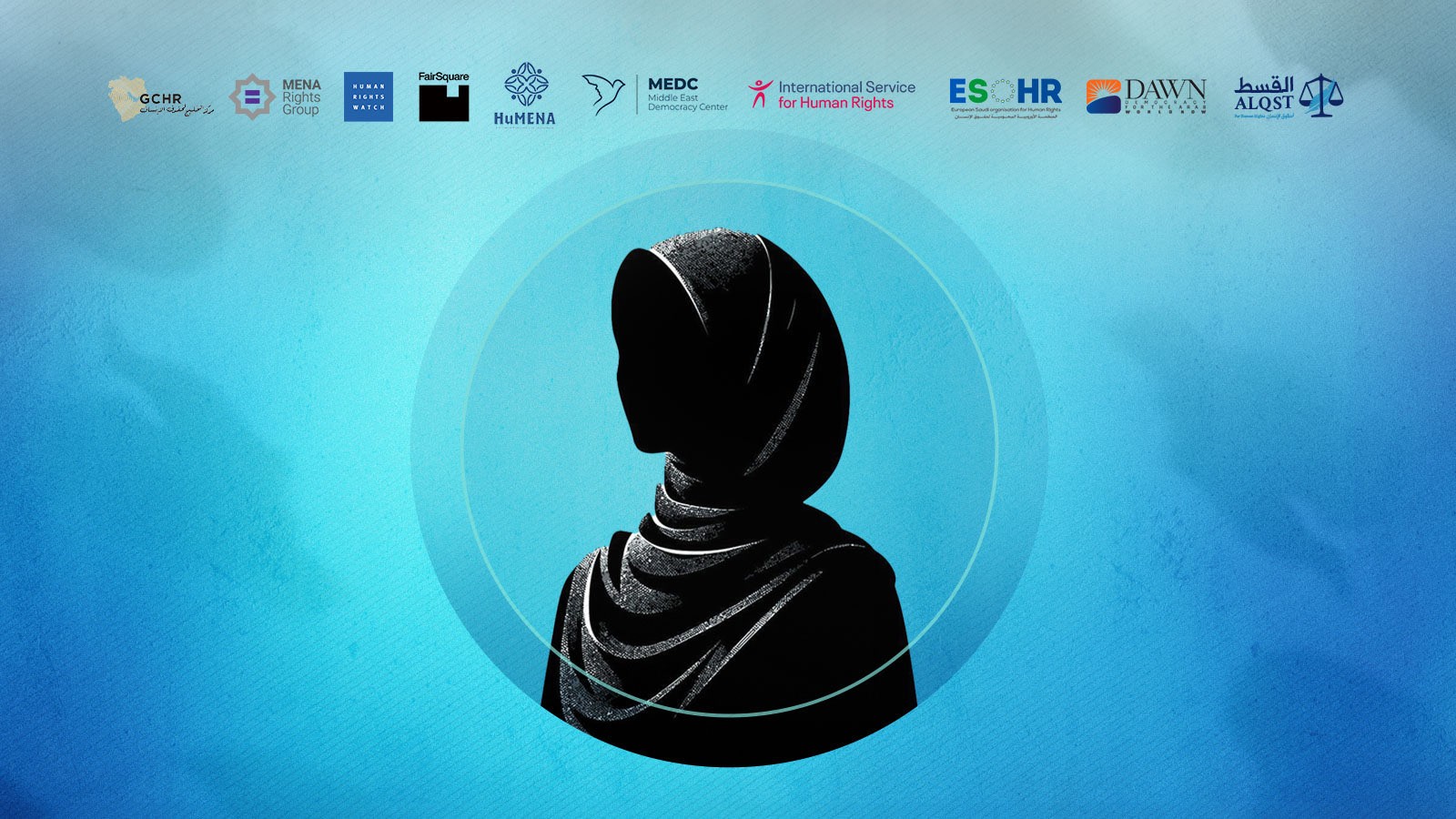
We, the undersigned civil society organisations, are extremely concerned that Nourah bint Saeed al-Qahtani has been held in solitary confinement in Saudi Arabia since February 2025, precipitating a rapid deterioration of her health, according to ALQST. We call on the Saudi authorities to release her at once and immediately provide her adequate medical care.
Al-Qahtani, a 51-year-old mother of five children, including a disabled daughter who relies heavily on her mother’s care, was sentenced by the Specialised Criminal Court in August 2022 to 45 years in prison. She was retried in September 2024 and subsequently resentenced to 35 years in prison followed by a 35-year travel ban. While a slight reduction on her earlier sentence, this punishment remains a travesty of justice. Her conviction was based on allegations of using Twitter accounts to criticise government policies and to call for the release of human rights defenders. She was also charged with possession of a banned book.
In July 2023, following a complaint submitted by NGOs, the UN Working Group on Arbitrary Detention adopted an Opinion calling for al-Qahtani’s immediate release, deeming her detention arbitrary and in violation of international human rights standards.
Al-Qahtani’s case serves as a potent reminder that, despite a recent spate of prisoner releases, the Saudi authorities are continuing their relentless crackdown on peaceful dissent and harsh treatment of targeted prisoners. In recent years they have frequently subjected prisoners of conscience, and others arbitrarily detained, to solitary confinement, incommunicado detention or even forcible disappearance. Leading international standards treat prolonged solitary confinement for more than 15 days as a a violation of the absolute prohibition on torture and other cruel, inhuman or degrading treatment: Noura al-Qahtani has now suffered this gross violation of her rights for more than two months.
Her case also illustrates the way in which the authorities continue to violate women’s rights, particularly the rights of those who advocate for women’s freedoms in defiance of the official narrative of top-down women’s empowerment. Other women activists, such as Manahel al-Otaibi and Maha al-Rafidi, continue to suffer severe violations in jail, including denial of medical care and access to legal representation. Others who have been released, such as Loujain al-Hathloul and Salma al-Shehab, continue to suffer from severe restrictions on their liberty, including travel bans that prevent them from joining their families abroad or pursuing educational and work opportunities.
We call on the Saudi authorities to immediately and unconditionally release Nourah bint Saeed al-Qahtani and all others detained for peacefully expressing their opinions. Pending al-Qahtani’s release, the authorities must ensure her safety and access to adequate medical care.
Signatures:
- ALQST for Human Rights
- DAWN
- European Saudi Organisation for Human Rights (ESOHR)
- FairSquare
- Gulf Centre for Human Rights (GCHR)
- Human Rights Watch
- HuMENA for Human Rights and Civic Engagement
- International Service for Human Rights (ISHR)
- MENA Rights Group
- Middle East Democracy Center (MEDC)