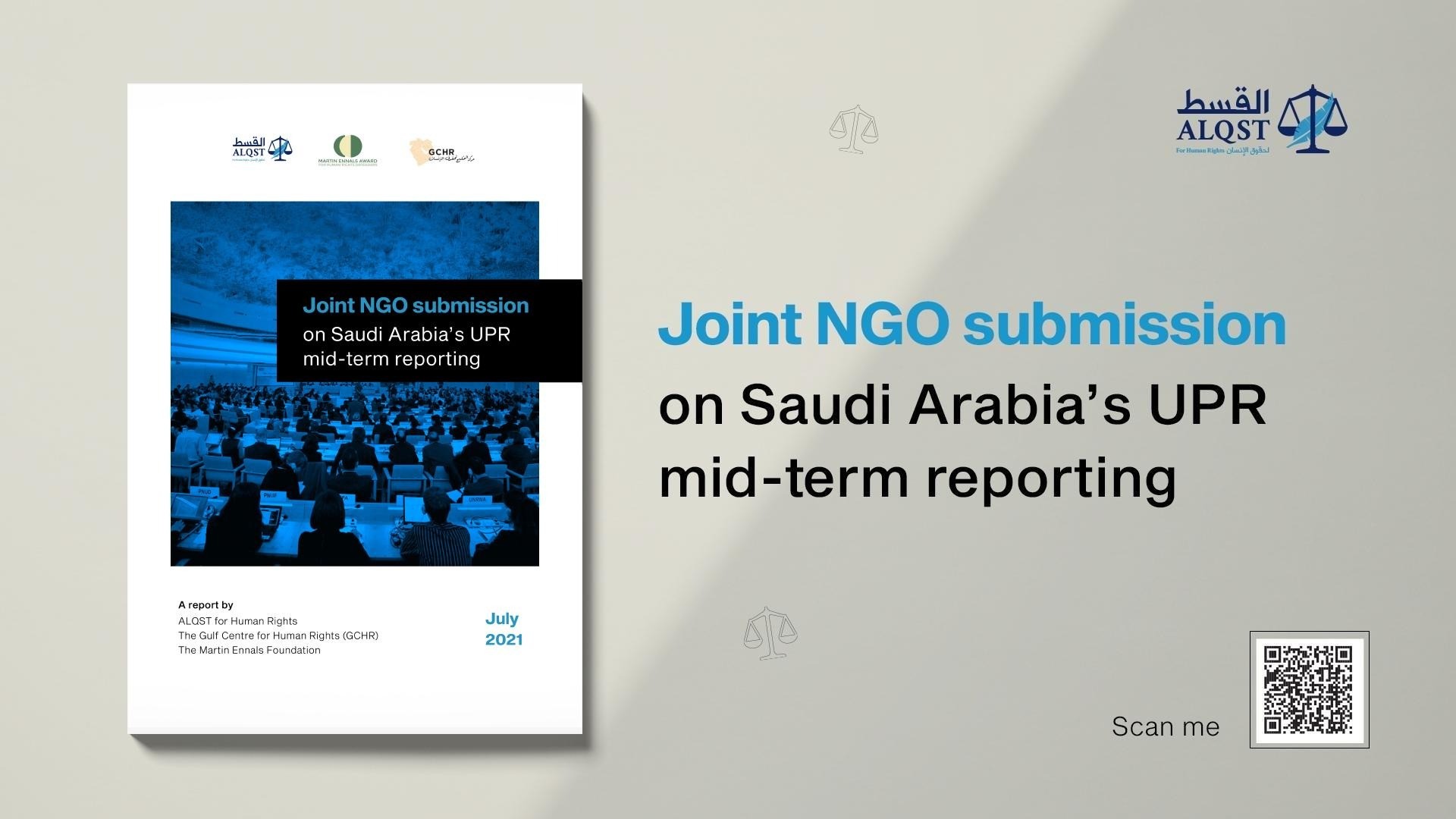
An NGO report on Saudi Arabia’s progress mid-way through its Universal Periodic Review (UPR) cycle reveals a shocking lack of action from the Saudi authorities on recommendations to improve human rights that they accepted in 2018.
The 27-page report, submitted by ALQST, the Gulf Centre for Human Rights (GCHR) and the Martin Ennals Foundation, shows that despite formally accepting many of the 258 recommendations received during Saudi Arabia’s third-cycle UPR in 2018, the Saudi authorities have made little to no progress in implementing them, while continuing to carry out systematic human rights violations.
Introductory concerns
The Universal Periodic Review (UPR) of Saudi Arabia in 2018 has been followed both by high profile violations as well as an ongoing approach to systematically prevent any improvements. A review of the changes that have been made have shown them to be largely cosmetic. Where changes to the law have been made, they have been cancelled out by other new or existing provisions or practices.
Furthermore, there are particular concerns over the broad use of vague or ill-defined legislation, including the Counter-Terrorism and Cybercrime laws to penalise freedom of speech, particularly when it comes to challenging the political authorities. Human rights defenders and other activists have been widely targeted by the authorities and the judicial system as noted in the many examples provided below.