X has become the latest social media platform to comply with requests from Saudi Arabia’s authorities to block scores of human rights and political accounts from reaching audiences inside the country. Together with similar measures taken in recent months by other major companies including Meta, Snapchat and YouTube, this constitutes complicity in the authorities’ sweeping attacks on the vital role of diaspora organisations and individuals advocating for human rights and democracy in Saudi Arabia and across the region.
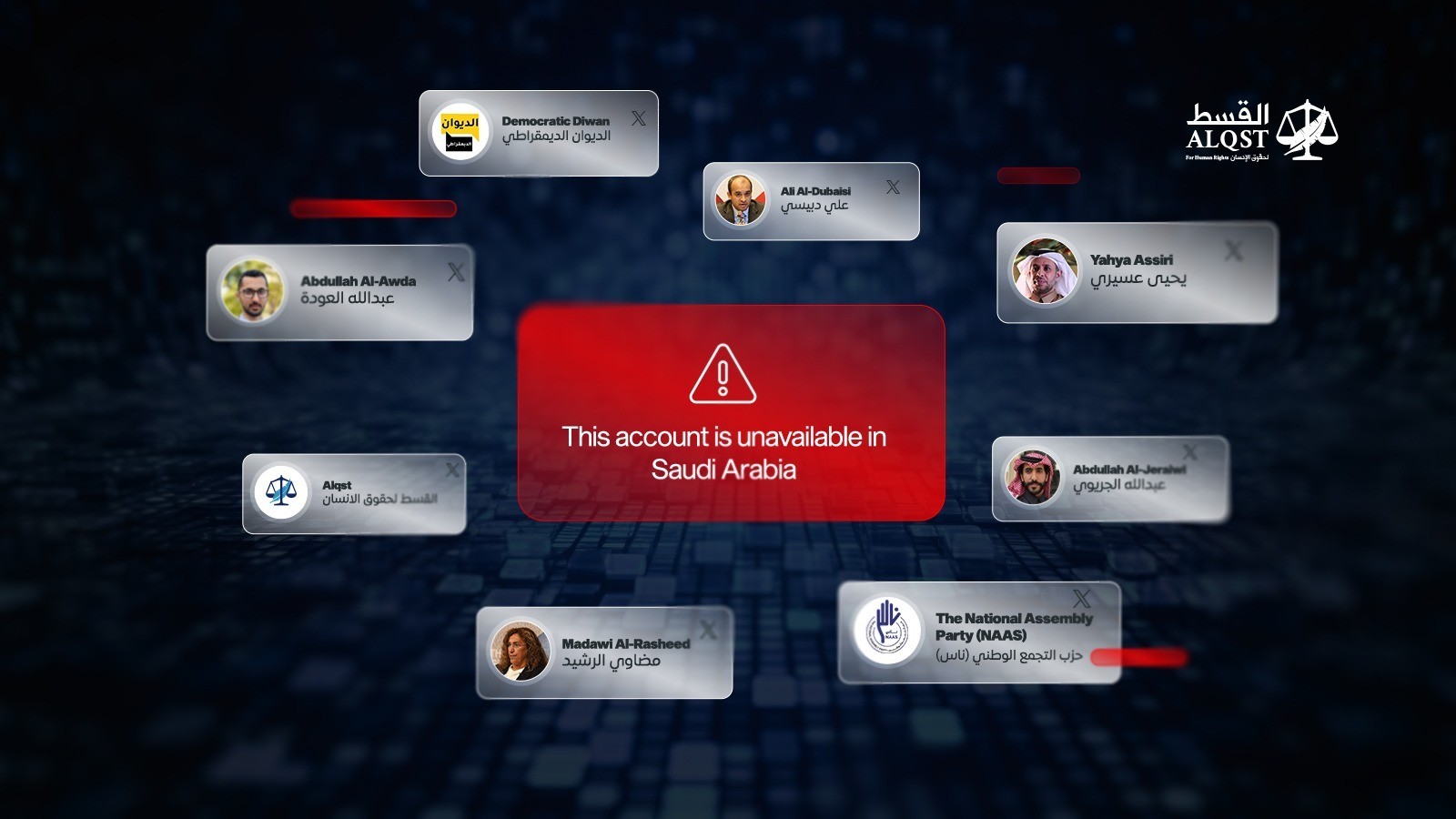
Since 13 July 2026 at least 65 accounts on X (formerly Twitter) have been rendered “unavailable” in Saudi Arabia at the request of the Saudi authorities, through a process known as “geo-blocking” that prevents users inside the country from accessing their content. Those affected include independent NGOs ALQST for Human Rights and Democratic Diwan; NGO founders and senior staff Yahya Assiri (ALQST), Ali al-Dubaisi (ESOHR), Abdullah Alaoudh (ACMER) and Abdullah Aljuraywi (ALQST, Democratic Diwan); academic Madawi al-Rasheed; the National Assembly Party (NAAS); and many Saudi activists living in exile.
The affected account holders received identical emails from X informing them that the company had received a request from the Saudi authorities and was taking action in order to comply with its obligations under Saudi Arabia's “local laws”. This followed a notification in late May on which X had initially taken no action. Attached to the emails was a ruling from the Saudi Public Prosecution, also identical in each case, alleging violations of the country’s draconian Anti-Cybercrime Law, including content deemed to have “infringed public order, religious values or public morals”. It did not specify which posts were alleged to have violated the law, nor offer any means to challenge or appeal the ruling.
X’s decision follows similar requests by the Saudi authorities to restrict accounts on other social media platforms. Since March 2026, Meta has geo-blocked over 100 Facebook and Instagram accounts – many of them held by those now blocked on X – at the request of the Saudi and United Arab Emirates (UAE) authorities. It too has cited compliance with the cybercrime laws of the two countries. Snapchat has also restricted accounts in Saudi Arabia, without even notifying account holders, and YouTube has taken similar measures. It is not clear how many Snapchat and YouTube accounts have been affected.
Taken together, these actions represent a renewed and sustained assault by the Saudi and UAE authorities on freedom of expression, and highlights the growing willingness of major technology companies to comply with politically motivated demands. For years, authorities in both countries have relied on vague and overly broad cybercrime and counterterrorism laws to suppress dissent and criminalise peaceful online expression. Countless activists and peaceful critics have been arrested, tried and sentenced simply for expressing critical views online, often on X. Authorities across the Gulf have tightened control over the information environment even further since the United States and Israel began launching strikes on Iran on 28 February 2026.
In this heavily repressive context, social media companies have a heightened responsibility to respect and protect their users’ right to freedom of expression. Moreover, the UN Guiding Principles on Business and Human Rights expect companies to assess whether government requests are consistent with international human rights standards before complying. However, instead of safeguarding the free flow of information these companies have chosen to restrict it further, despite public commitments by several of them to consider the human rights implications of such decisions.
The impact of these geo-blocking measures is hard to overstate. They amount to a severe and wide-scale attack on the ability of independent organisations and individuals to advocate for human rights and democratic reform in Saudi Arabia and the wider region. The impossibility of independent NGOs operating within Saudi Arabia or the UAE, and the grave risks faced by individuals inside them who speak out online, underline the importance of organisations and individuals in the diaspora, where growing numbers have been forced to flee over the past decade. As activism increasingly shifts into places of exile, authorities in both countries have extended their reach beyond national borders, using various forms of transnational repression to silence dissent.
Social media once provided one of the few spaces where people in the Gulf could, with relatively less fear, speak out, exchange views, and access independent information from outside their countries – which is a vital part of working towards long-term change and engaging the region’s young population. Yet in both Saudi Arabia and the UAE, authorities now exert near total control over online information, and routinely block websites and internet accounts that might be of public interest, such as the website of ALQST (blocked in Saudi Arabia since 2015).
ALQST condemns these arbitrary actions and calls on Meta, X, Snapchat and YouTube to immediately restore full access to all affected accounts. We also urge the companies to provide a transparent explanation of how these decisions were reached, to clarify whether they concluded that their actions were consistent with international human rights standards, and, crucially, to ensure that those affected have a meaningful opportunity to challenge the decisions.