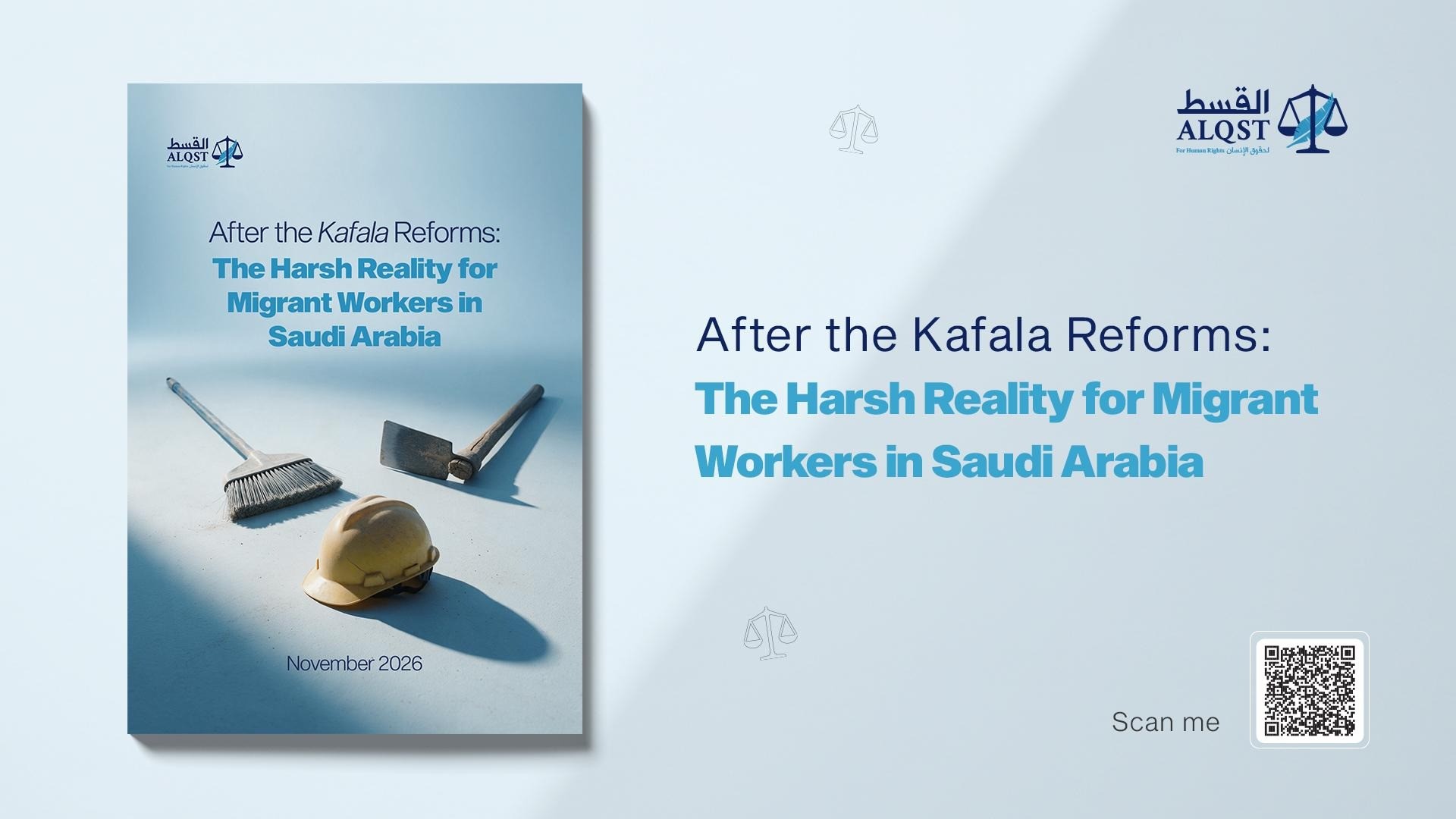
ALQST today publishes new research into conditions for Saudi Arabia’s estimated 14 million migrant workers, and concludes that despite official claims to have “abolished” the notorious kafala sponsorship system and replaced it with a modern, contract-based system of employment, the majority of these workers continue to face highly exploitative and abusive practices.
ALQST’s report, “After the Kafala Reforms: The Harsh Reality for Migrant Workers in Saudi Arabia”, is partly based on a new survey of migrant workers and includes several harrowing case studies – such as a housemaid cut off from her family with years of unpaid wages, and a man driven across the Yemen border and dropped in the desert.
On 2 March 2025, the Saudi authorities published a lengthy description of purported reforms to the kingdom’s labour laws and regulations, including the claim that the decades-old kafala system, which makes foreign workers dependent on their Saudi employers’ sponsorship, had been abolished and replaced with a new contract-based system of employment. This was supposed to increase workers’ freedom of movement and protect them from wage theft and other violations. The article appeared to refer to reforms announced in previous years, notably the Labour Reform Initiative of 2021. Yet ALQST’s findings confirm that over a year and a half after even this relatively recent announcement, the labour system continues to operate largely as before, and employers widely exploit loopholes in order to continue to commit major violations.
Key findings include:
- Worker mobility remains restricted
While a worker may now legally leave the country when their contract ends without a permit from their sponsor, they must apply through a website available only in Arabic and English and pay a processing fee, and the sponsor can still object to the request. The system therefore remains open to abuse, and passport confiscation remains common. Workers can also now change employers if they find a new job at the end of their initial contract, and in theory before this as well, but only under prohibitive conditions involving financial and contractual penalties and heavy transfer fees. ALQST has documented cases of workers being scammed in such situations.
- Protections against abuse and exploitation remain inadequate
In the absence of criminal liability for putting employees at risk, migrant workers continue to face unsafe working conditions that often lead to unexplained and uncompensated injuries and deaths. ALQST’s survey, conducted between March and May 2026, also revealed high levels of wage theft and false absenteeism reports: two-thirds of respondents said they had gone months without receiving their wages, and more than a quarter reported being falsely registered as absent from work, rendering them vulnerable to deportation while denying them outstanding pay. Meanwhile, despite official prohibitions, migrant workers continue to be charged substantial recruitment fees, often leaving them heavily indebted before arriving in Saudi Arabia. ALQST has also documented cases where workers have experienced discrimination based on race and nationality, and since government policies maintain nationality-based restrictions on access to certain professions, some workers end up in jobs that do not reflect their qualifications or experience.
- Domestic workers remain particularly vulnerable
Domestic and agricultural workers, who make up a significant proportion of migrant workers in Saudi Arabia, are governed by a separate legal framework and are excluded from many of the recent labour reforms. The updated Domestic Workers Regulations, published in 2025, still offer inadequate protection. Female domestic workers face particular barriers to reporting violence, accessing justice and obtaining protection. Exploitative practices amounting to modern slavery or human trafficking have also emerged, partly in response to high recruitment fees.
- Access to justice remains severely restricted
Migrant workers face enormous obstacles in seeking redress for abuse and labour violations. Saudi Arabia’s judicial system, which lacks independence and relies on judicial discretion (ta’zir), compounds the disadvantages faced by migrant workers, many of whom are debt-ridden and unable to speak Arabic. Legal aid is rarely available. Workers who suffer abuse are often left only with the option to leave Saudi Arabia at considerable financial cost, or remain and risk arrest and deportation. Once deported or having returned home, their ability to pursue justice is virtually eliminated.
- Saudi workers suffer consequences too
The exploitation of migrant workers also undermines labour standards across the Saudi economy. With migrant workers making up around three-quarters of the workforce, widespread acceptance of unsafe conditions, low pay and poor treatment risks normalising these practices for all workers, including Saudi nationals.
Nadyeen Abdulaziz, Monitoring and Advocacy Officer at ALQST, comments: “These findings show that Saudi Arabia’s labour system remains wide open to abuse and migrant workers continue to face widespread exploitation, driven by a deep imbalance of power, weak enforcement, and a lack of political will from the authorities. As Saudi Arabia seeks to attract more workers, including in the lead-up to the 2034 World Cup, tangible reforms are urgently needed to end this cycle of exploitation and save lives.”
ALQST’s report concludes with a series of detailed recommendations to Saudi Arabia’s authorities, as well as to labour-sending countries.